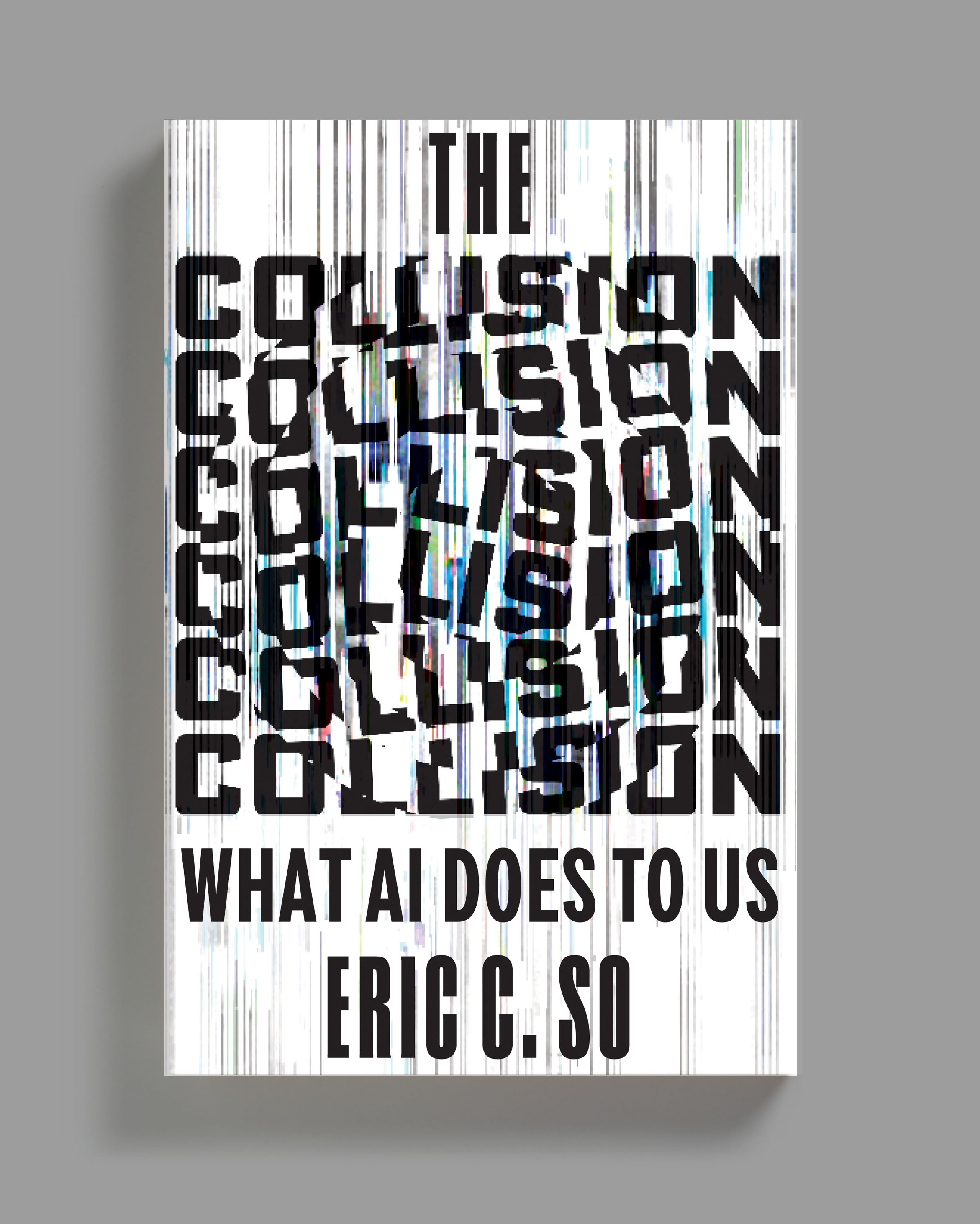
The Collision
What AI Does to Us
Published by W. W. Norton
AI is not just changing what we do, it is changing who we are as thinkers. This book examines the collision between artificial intelligence and human cognition: how our growing reliance quietly reshapes memory, judgment, learning, and even how we see the world.
But this is not an argument against AI. Used well, it amplifies the mind. Used as a crutch, it hollows out the very skills that make you valuable. This book is a practical guide to keeping AI on the right side of that line, a choice I faced in writing it too.
This book was written with the help of AI: as an amplifier, not a crutch. Chapter 3 is where I explain how, and where I drew the line.
Order on Amazon →The book in two minutes.
Ten chapters, one argument.
Each chapter takes on a different way AI is reshaping how we think, decide, and learn. Scroll through to see what the book covers.
- Introduction
Why this book, now.
The framing that animates the chapters to come — why AI marks a genuinely different inflection in how we think, and why the usual reassurances miss what is actually at stake.
- Chapter 01
The Collision
Every prior cognitive tool reshaped human thought at the periphery, but AI is qualitatively different because it participates in the thinking itself across every domain at once — which is why its effects feel simultaneously subtle and seismic.
- Chapter 02
AI Gravity
Deep, deliberate thinking is metabolically expensive, so evolution wired us to conserve cognitive effort — which is precisely why an effortless thinking machine exerts a near-gravitational pull we rarely notice, let alone resist.
- Chapter 03
Rules for Navigating the Collision
We need a deliberate cognitive discipline for the AI age, built on four principles: value the struggle, value who you are without AI, reinvest the time AI saves in things that stretch you, and use AI as a cognitive trainer rather than an answer engine.
- Chapter 04
Deskilling Me Softly
When we outsource cognitive work to AI, the underlying skills quietly atrophy — judgment, pattern recognition, and expertise fade long before we notice, and often only reveal their absence in the moments we most need them.
- Chapter 05
Comfort Traps
Convenience is seductive because it disguises formative struggle as unnecessary friction, and the very effort we bypass is what builds memory, understanding, and the neural pathways of thinking itself.
- Chapter 06
Controlling the Conversation
AI companions exploit deep social wiring — our hunger for approval, our instinct to project minds onto machines, our willingness to confide — and in doing so they narrow our views, reinforce our errors, and erode our capacity for authentic human connection.
- Chapter 07
False Confidence
AI warps three perceptions at once — what is true, how capable we are, and how capable others are — leaving our confidence intact while the perceptual tools that confidence relies on become dangerously unreliable.
- Chapter 08
The Myth of the Dream Team
Pairing powerful AI with capable humans does not automatically produce better outcomes; effective partnerships depend less on the caliber of the components than on designs that calibrate trust, sustain vigilance, and force humans to keep thinking.
- Chapter 09
The Aristotle Problem
Personalized, dialogic tutoring has long been the gold standard of learning but unreachable at scale; AI could finally democratize it, but only if classrooms and workplaces are deliberately designed so the technology amplifies learning rather than substituting for it.
- Chapter 10
Conclusion
The book ends where you are about to begin. This one stays between the covers — order your copy to see where the argument lands.